
Hardeman Parole and Probation
Texas assigns parole and probation to separate agencies. Parole is release from a TDCJ prison while the sentence continues under TDCJ Parole Division supervision. Mandatory supervision is another state-prison release mechanism governed by statute and a Board of Pardons and Paroles decision where review is discretionary. Probation, called community supervision in Texas law and court records, is imposed by a court and managed by a community supervision and corrections department. Someone may leave Hardeman County Jail for probation without ever entering TDCJ. Another person may leave the jail only as a transfer to TDCJ, then later receive parole from a prison unit.
The agency split controls where to verify the status. TDCJ and BPP records address parole. The judgment, later court orders, and the regional CSCD address probation. Neither label means every hold has cleared, and neither should be inferred from a name disappearing from county custody.
| Point | Parole | Probation |
|---|---|---|
| Who orders it | Texas BPP decides release from prison | A criminal court enters community supervision |
| Who supervises | TDCJ Parole Division | Wilbarger County CSCD regional grouping |
| Core proof | Actual TDCJ release and supervision status | Judgment or supervision order |
| How it ends | Discharge or other final TDCJ action | Court discharge, termination, or revocation order |
- Parole
- Conditional release from prison while the sentence remains active.
- Probation
- Court-ordered supervision in the community, often instead of prison.
- Discharge
- The recorded end of the sentence or supervision obligation.
- Absconder
- A person alleged to have stopped reporting or complying with supervision.
Verify Hardeman Release Supervision
Begin with the custody level. A Hardeman County booking/release record can show whether the person left on bond, probation, time served, transfer, or another code. If the sheriff records a TDCJ transfer, the county event was not a community release. If a state-prison term followed, use the TDCJ inmate search while the person remains incarcerated and the BPP offender and current-vote search for parole-review information. Match a TDCJ or SID number, date of birth, conviction county, offense, and dates rather than relying on a shared name.
A favorable BPP vote is one step, not proof of a door-out date. TDCJ still handles the approved plan, conditions, identification, required programs, detainers, and release processing. Seek an actual release date paired with parole or mandatory-supervision status. For probation, request the judgment, supervision order, and any later modification, revocation, early-termination, or discharge order from the Hardeman County/District Clerk.
- Ask the sheriff whether the named booking ended in community release or transfer.
- For a prison case, search TDCJ and BPP with official identifiers and note the access date.
- Distinguish an approval vote, a projected date, and a completed physical release.
- For probation, obtain the court order and identify the CSCD assigned to the case.
- Confirm the serving office because residence and specialized caseloads may place supervision elsewhere.
Hardeman Probation Office Region
Hardeman County probation administration is regional, a detail that prevents many misdirected calls. TDCJ Community Justice Assistance Division material groups Foard, Hardeman, and Wilbarger Counties under the Wilbarger County CSCD listing in Vernon. That department handles community-supervision functions. It is not the Texas parole board, and it cannot substitute for a BPP parole decision. Since reporting sites and instructions may change, confirm the assigned office before traveling.
Wilbarger County CSCD
Wilbarger County Courthouse
1700 Wilbarger Street, Room 21
Vernon, TX 76384-4748
Phone: (940) 552-2702
Fax: (940) 552-2833
The court record remains vital even after an office is located. It shows whether supervision was imposed and whether a judge later modified, revoked, ended, or discharged it. CSCD staff can explain office procedure and routing, but access to person-specific details may be limited. Bring a cause number and use the exact name appearing in the judgment when asking about a filed order.
Parole office assignment works differently. The approved residence and any specialized caseload can put a releasee under an office outside Hardeman County. Use the TDCJ Parole Division directory rather than assuming the conviction county controls. This regional split is the distinctive local feature of Hardeman supervision: probation calls go toward Vernon, while parole remains in the statewide TDCJ system.
Note: Confirm the current reporting address with the agency because a published regional administrative listing may not match an individual’s reporting instructions.
Hardeman Parole Review Records
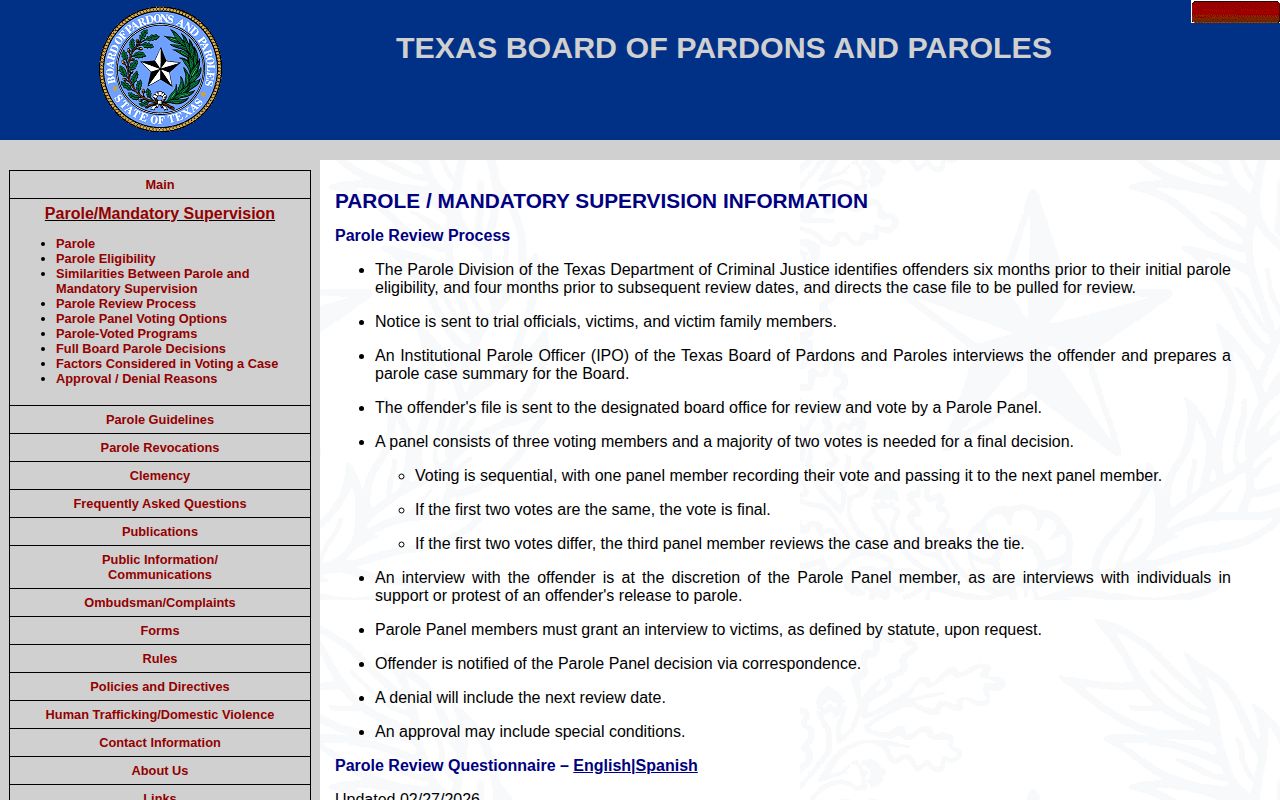
The Texas Board of Pardons and Paroles decides parole release. Ordinary review is an administrative file-review process, not a public courtroom hearing for each person. TDCJ identifies cases before review, an Institutional Parole Officer prepares a summary, and a three-member panel votes in sequence. Two matching votes decide the case. The BPP parole panel explanation says formal hearings are not held for routine parole or mandatory-release consideration.
Review timing is not a release schedule. BPP information says cases are generally identified about six months before initial eligibility and four months before later review. Outcomes can include approval, denial with another review month, program-contingent action, or other coded votes. FI-1 can mean release when eligible, while other FI or treatment-related codes add timing or program conditions. Definitions must be checked live because a vote can change or be withdrawn when new facts arrive.
The official parole review process explains the file path. For person-specific status, use the BPP search or call 844-512-0461 with the person’s name, TDCJ-CID number, or date of birth. Post-approval release-processing questions route separately to 512-406-5202. A board meeting notice is about formal agency business and must not be treated as a person-by-person parole calendar.
The Texas parole review page illustrates the official administrative process.
Hardeman Supervision Warrants
An absconder label generally means the supervising agency alleges that the person stopped reporting or failed to comply. It can lead to a warrant, but it does not erase the original prison release date. A parole warrant, often called a blue warrant, may return someone to county custody while revocation is considered. The live custody event and the supervision case must therefore be checked separately.
Hardeman County does not publish a verified local absconder or warrant list on the official sheriff page. For parole, check TDCJ and BPP information and contact the serving Parole Division office. For probation, seek the latest court docket and ask the regional CSCD about general routing. If the person appears at Hardeman County Jail, the sheriff can confirm current custody, but the parole or probation authority explains the supervision action.
- A violation allegation is not the same as a final revocation.
- A warrant does not change the historical physical-release date.
- A county booking may arise from parole or probation action.
- A new charge and a supervision case can proceed on separate tracks.
Texas IVSS-Counties may provide custody-event alerts if Hardeman participates, but it is not a certified supervision record. A transfer alert also does not mean return to the community.
Hardeman Supervision Discharge
Supervision ends through an official act, not by the passage of an assumed date. For parole or mandatory supervision, obtain TDCJ/BPP information showing the final status and sentence discharge. Government Code Chapter 508 governs parole and mandatory supervision, including eligibility and exclusions. Eligibility merely allows review; it does not confer release or establish discharge.
For probation, the filed court record is the sound source. Look for an order of discharge, early termination, revocation, or another final action. The combined clerk’s online document research begins with records dated October 31, 2006; older material is kept in courthouse books. That split can make an office search necessary for an older Hardeman County supervision case.
The Hardeman County released-inmate search and records overview explains how to pair a supervision record with the sheriff’s actual release entry. Together, the records show when custody ended, which authority took charge next, and whether the sentence later reached discharge.